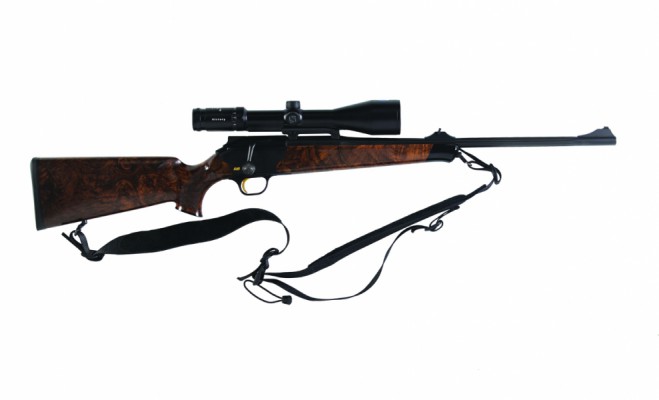
Via Mas Ayoob, I now hear of the RifleMann Sling, which might prove to be interesting.
Via the Galco website, there are a few further pictures, but I'll have to hear and see more before truly concluding further. Based just on the pictures, I wonder if it may be more a takeoff of the Safari Ching Sling, than on the original design by Eric Ching. (Galco certainly seems to consider the Safari Ching Sling to be a full replacement for the original, which it is absolutely not*; I will be a little bit naturally skeptical at Galco's marketing in this regard.) And I can't tell whether the use on the shooting arm is anything more than just "hasty"-ing it around the outside, or not. It seems that this might have some utility somewhere, but it's missing a huge part of the "gun mount" without any sort of support under the rifle, and it would be hard to imagine that the lockup is anywhere near as solid.
I'm willing to be convinced, but the standard is high. Anyone else hear any scuttlebutt?
______________
* It's a simple matter of speed, and fidelity to the original idea. One of the features of the original Ching Sling is that you can get into it--solid lockup--faster than you can acquire your supported position. The Safari Ching Sling is a great idea when you're limited to two sling studs (I use mine whenever borrowing a rifle that doesn't have three studs), and certainly gives great lockup, but there is no way it can ever be as fast and forgiving as the original. If you simply want a solid sling on a two-stud rifle, the Safari Ching is probably the best thing going. But if you want the full, original idea--the ideal sling for solid lockup at maximum speed--you want the original.
As I was writing this, I had already been thinking about making it into a post of its own, because the topic seemed to be worth it. The following was inspired by one of Mama's insightful comments, and once Blogger told me it was too long to be a comment, it was reasonably easy to say, "okay, Blogger, fine...I'll make it into its own post."
As a "contextual continuity clue": the following relates to several posts I've got here at Rifleman Savant, in which something relating to a Jeff Cooper topic--scout rifles, Ching slings, gunhandling technique, etc.--struck me as so far off the mark of what Cooper actually said or intended, that I felt the need to vent about it. Mama's comment got me thinking about that, and I responded as follows:
Maybe it's just a normal phenomenon that accompanies middle age, but I am really starting to grasp the wistful frustration that I so often read as a younger man (without really understanding) in Jeff Cooper's work. Or, maybe it is a natural outgrowth of a long-cultivated appreciation of deliberate design. (And really, I suspect strongly those two things are quite related.) But whatever the reason, it seems like the "...how often they do very badly at it" observation comes frequently in recent years.
I'm certainly not without my own history of jumping in to something before fully understanding it, but I like to think that I am learning that it always--always, without exception--fails to achieve full value, or at least full synergistic value. Probably these days I go too far the other way, where the biggest risk is in missing the window of time for which the whole idea has currency.
With something like this [a "scout rifle" missing critical features or implementing others badly], or like my recent lament about misunderstanding the technique of the speed sling, I wonder if the bigger problem is less the people whose well-intentioned exuberance carries them into a place they do not understand, and more the problem of chest-thumpery among those who purport to know, but don't. How do the consciously ignorant know that they are not following the unconsciously or willfully ignorant?
The position I'm in myself is a real challenge, in this regard. Anent the observations and teachings of Jeff Cooper, I tend to minimize how much I actually know, since 1) it's kinda my personality in general (I like being underestimated), and 2) I don't have a CV of "official" credentials that say I know what I know. But know it I do, both because I have long paid really close attention to matters of design and the history of design, and because I have tested nearly all of it myself and understand why it works from that perspective. And so when something misses the mark, it jumps out at me like nails on chalkboard, and I can both quote chapter and verse, and then defend it extemporaneously.
But who am I, really, to speak with authority on it in the first place? I only met Col. Cooper, in person, once. I have never "been in a gunfight" (and am quite happy about that, no joke). I'm no sort of master marksman, nor particularly fast. I've never got into formal competition, and I get quite a bit less trigger time than it would require to impress a good number of people. And so I try, at least, to minimize my own authority, because I can't really argue that I have it. Shooting, for good or ill, seems to carry an expectation that "experience" equals "analysis".
On the flip side, I am reminded of how much I really do know, and at what level of explication and depth, pretty much every time I engage with someone else, even those with years of shooting experience. I couldn't even tell you the number of people I've met who know simply astonishing minutiae about how to wrest a tenth of an inch of group size from their precision fitted boltgun, at exactly 100 yards, from a bench--who have no idea how to use their own body, much less a shooting sling, to shoot from an unsupported field position with any stability; or how to zero their rifle to optimize a "maximum point-blank range" for what they will be most likely to encounter in the field; or how to manage their ammunition supply without looking at it; or even how to run the bolt from the shoulder... It's a little better for pistolcraft, but not a lot. There's been a depressing resurgence in the concept of unsighted pistol fire, usually declaring loudly a complete non-understanding of the flash sight picture. The "high-speed, low-drag" tactards have convinced far too many that "two to the chest, one to the head" is nothing but a speed drill, rather than the observation-and-problem-solving technique that it is. The "cold range" mentality, as understandable as it can seem, continues to retard any general improvement in safe field gunhandling. And so on.
It's hard to say simply that people need to be more observant, although that seems like an obvious part of the solution. "Try it yourself, before you believe or disbelieve" would seem to be another obvious one, as would "go to the source, after you hear it second-hand". But a really substantial part of the problem is also those who stand up and loudly say "Lookit me, I know!", and then don't. When it comes to things that Cooper taught (both the gold and the stuff that really does need re-thinking), I usually know, immediately, when someone is wrong. But does that make me right? I struggle with that, but I also don't want to see such an immense reservoir of knowledge and history simply forgotten, or worse, revisioned by people who didn't really understand it in the first place.
Got back to the zeroing range today. After last week's frustrating attempt with handloads, and without the time to find and remedy the problem at home, I ponied up for some good factory loads, and today was...much better.
I was a bit paranoid--after all, maybe it was just me: you know, my shooting. So I brought some of that good old M80 ball to shoot first, just so I could see if I could hit anything, and see where my sights might have been left over after last week. So, at the 100 yard line, I shot my first three.
Click to embiggenate.
Well hell, that's a lot more satisfactory than anything I did a week ago. The aim point was the diamond to the lower left, so the group is about 2.5" high and 2" right. And importantly, it's a useful group, at a bit over an inch in dispersion.
Okay then, that's where the 147-grain load hits. Lovely. How about the Barnes VOR-TX 165-grain load?
First shot at bottom, next three above that, next three at top.
The first shot is the lowest one. Works for me! Now to raise the point of impact to about 2" to 2.5", to give me a good "maximum point-blank range" for a 6-inch target diameter. (Both moose and caribou are much bigger than that, of course, but I figure this gives me a margin of error in my own shooting.) I moved the reticle adjustment up a bit and shot three, and you can see the next three shots right above and to the right of the first one. Nice tight group, but not quite as high as I wanted, so I went a bit further--and as you can see it was a bit too far. Not only that, but the point of impact moved to the left at the same time! (This is why you never adjust both planes at the same time. :-)
And by this point I was feeling much better about my shooting. A 2.5x scout scope is not exactly made for benchresting, and lots of people pooh-pooh it as being "underpowered", but as you can see it certainly can work! But 3.5" is a bit too high. Okay, back it down just a bit and shoot three (new target).
Good enough to hunt with! 1/2" right and just over 2" high.
This should give me just over 250 yards of MPBR and about 9" of drop at 300.
Now we're talking. Back over to the right, okay, but more importantly just about the right height. Using JBM Ballistics, and presuming about 2600f/s of muzzle velocity from the Scout's 19-inch barrel (I didn't chrony today), the two points of intersection with the line of sight should occur at exactly 25 yards and exactly 200 yards, with a MPBR of just over 250 and about a 9" drop at 300. If for some reason I'm seeing the full 2700fps claimed on the box (which I'd not expect, but that Mannlicher barrel is known to shoot a bit faster than its short length would suggest), the numbers are little different: 0.1" down at 25 yards, 0.4" up at 200, MPBR of 265, and a drop of 8" at 300. If for some reason I shoot well enough in the field to notice that, I'll...well, I won't, so no matter.
What's important to me is that I know that trajectory already, and I'm confident to 300 for hits with it. (Actually, I'm reasonably confident to 400 with a good steady rest, but I'm also of the opinion that you have to apologize for shooting that far away, and at any rate the problem out past 300 isn't so much setting the holdover properly, as it is being accurate about range estimation. On a wounded animal getting away, sure, but I won't go that far for a first shot.
Okay, so I'm happy now, with zero. I figured I'd finish with a quick test of position skills. Using the M80 ball, which I know shoots a bit high and right relative to the Barnes, I shot one round from each position at a pistol target at 100. The first three positions (squat, sitting, prone) used the Ching Sling, into which I looped up while acquiring the position; the fourth was bipod prone; and the fifth was an offhand shot, completely unsupported. Each shot was acquired and delivered as fast as I could get a good position, sight picture and compressed surprise break--this was supposed to be "under pressure". Of course, I snapped the bolt at each shot as well, and quitted each position reloaded and on-safe.
Yes, I'm happy with this as a quick test. About 8" total dispersion, including offhand.
The aim point was the orange center on the pistol target; I did not make any attempt to "Kentucky windage" any of these shots, even though I knew the ball load would print a bit higher and more to the right than the one I'm using "for blood"--which itself is zeroed about 2.25" high at this distance. The offhand shot is over on the far right, at the edge of my "wobble zone", but it was within the zone, and delivered within about three seconds--yeah, I'm happy with it.
The supported shots, again taken as fast as I could manage them, show a dispersion of under 5", with an apparent center about 1.5" right and a little over 5" high. If the ball load really does print about 2.5" higher and 2" to the right of the Barnes load, this would seem to suggest a group center of...about 2.5" high and within half an inch of right on for windage... Yeah, I realize that's at least a bit of academic reasoning there, but still, if the purpose is to instill confidence, I'll take it.
Now...for the problem of finding the critter at the right time, and getting close enough for a good shot. I think I can say now that if I get such a shot and blow it, it's on me, not on the rifle or the ammunition.
Grr. I have thus far found some things to like about Rob Pincus, especially his general educational style, and I find myself wanting to find more to like. Today, purely by accident, I happened across this link to a Personal Defense Network video which is titled "Scout Rifle as a Self or Home Defense Weapon".
Well, wouldn't that be cool. Let's watch! And there he is, displaying what is clearly a custom rifle on what looks like a Rem 700 action, complete with Ching Sling, intermediate eye relief glass, reserve irons, and even a butt cuff. And he launches into an explanation of the Scout concept in his own presentation style, even leading with Jeff Cooper's name as the principal force behind the concept. Cool!
The geek in me - sure, call me a Scout fanboy if you will - cringes a little at a few of the details, but they're mostly minor. He stumbles through the utility of a fixed magazine within a concept that values compactness over capacity, he holds the rifle like a carbine, he only runs the bolt from the shoulder when intending multiple shots, and he never even mentions the ability to reach way out there. Okay, so he's primarily a "defense" guy, and tends to stick to his primary audience. I understand that grousing on things like that would be more fanboy than fundamental.
But I must conclude that he has absolutely no idea what the point of the Ching Sling is.
At about 3:40 on the timeline he starts the demo of the sling, taking pains to point out the "extra connection", and then...he simply ignores it entirely, using exactly the textbook "hasty sling" technique that the Ching Sling was conceived to improve upon.
Jeff Cooper often wrote about how surprising it was to him, to discover how few people actually understood the shooting sling at all any more. A true shooting sling, to him, was more important than a glass optic on a rifle, because "the glass only helps my seeing, but the sling helps my holding". I can remember first reading that as a young man, and going to the trouble to test myself with what he said--and it is true. I can hold fully a third better when locked up with a sling, than from the same position without one.
The shooting sling works because it steadies the "gun mount" that is comprised of the ground, your body, the sling, and the rifle. Anatomically, the most effective way to do this is to take responsibility off of muscles, and give it over to bones. A "hasty sling", in which the arm is simply snaked around the rifle's carry strap, provides a small amount of tightening, but it is absolutely not the same thing as having your skeleton locked so tightly to your rifle that you can relax all muscles without your sights moving.
And only certain positions work with slings. (Offhand is not one of them.) In order to get a solid lockup, both elbows must be supported--remember, bone, not muscle. Prone is obvious, and sitting; the one that is not obvious but is surprisingly effective is the squat. (Kneeling doesn't get full value out of the sling because the strong-side elbow is still flying around in the air under muscle power alone.) The thinking here is that if you really need the precision of a sling, then you have time to get into a steadier position; if your need for speed is truly such that you don't have time to loop up, you probably shouldn't be bothering with a sling at all.
Which brings us back to the Ching Sling. It is the pinnacle of design for a shooting sling that can also be fast. (Hell, the old-fashioned military loop sling provides excellent lockup, if you take the time to get into it.) The key to effective lockup is that you must have the sling pulling exclusively forward on the support arm, as high up on the tricep as you can get it. Then, with the support arm elbow both under the rifle and resting on the ground (prone) or knee (sitting, squat), and the strong-side elbow resting either on the ground (prone) or knee (sitting, squat), with a properly adjusted sling and a good position, you really can achieve a lockup that will allow you to relax the muscles in both arms without moving the sights.
There are still people around who understand the military loop sling and the lockup it provides. It's no joke, right? But it's not fast, even with competition cuffs, and an ideal sling would be both convenient as a carry strap, and fast as a shooting sling. IIRC it was in the 1980s that Cooper first happened upon the idea of a "speed sling" from his friend Carlos Widmann in Guatemala. (Here's an American Rifleman reprint of his essay on that discovery.) Its only drawback was that it was clumsy to move back and forth between shooting mode and carry strap mode: for a shooting sling that could lock up essentially as fast as you could acquire a position, it was a shame to have to pick between modes.
That is what Eric Ching solved with his invention of the sliding-strap Ching Sling. You have the lightning-quick, solid lockup of the two-forward-stud Widmann system, and the carryability of a main strap spanning the two conventional studs. Its performance really is rather remarkable, and Cooper was rather forceful in specifying it as part of the Scout concept. A Scout is a rifle which can be used either across the room or hundreds of yards away, and way out there, any of us can benefit from a little help holding steady; the Ching Sling makes it possible to get a loop-sling quality lockup while you are getting into position.
So it's a bit perturbing to see someone as trusted as Rob Pincus discussing the three-point sling on a scout rifle, with apparent reverence...and demonstrating instead a two-point conventional hasty technique. In a position that doesn't really benefit from a sling in the first place.
He's right that the Scout concept never caught on in the mainstream. Thing is, I suspect that at least some of the reason why that is the case, is that so few people seem to understand the concepts. "It's too short; it won't work at range" say the riflemen. "It's not semiautomatic," say the tactards. "Scope's not powerful enough." "Looks funny." "Won't shoot as far as my specialized sniper rifle." "Won't shoot as fast as my specialized tacti-carbine." And, "What's that short strap thingy for?"
Indeed.
We know what it's for. Cooper wrote about it many times. It's all right there in The Art of the Rifle. It's no secret. And yet it's no wonder that it hasn't caught on, if this is the way it's presented.